
PikaOS: The Linux Distro That Wants Gaming to Stop Feeling Like Homework
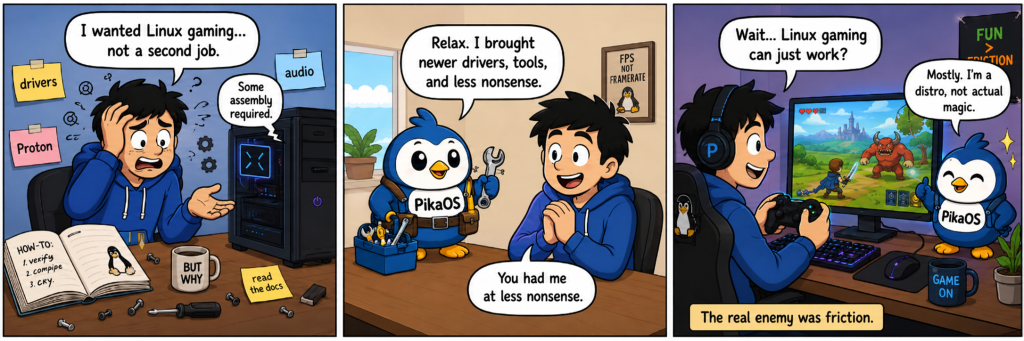
Linux gaming used to feel like a hobby inside a hobby. First you installed the operating system. Then you installed drivers. Then you hunted for the right Proton version. Then you fixed audio. Then you discovered your controller had opinions. Then, after three hours, you finally launched the game and called it a victory even if it crashed during the intro. PikaOS exists for people who are tired of that ritual.
At first glance, PikaOS is another Linux distribution aimed at gamers. That description is technically true, but a little unfair. Its own documentation describes it as a gaming and optimisation-focused Linux distribution built on a Debian base, with cherry-picked and custom-compiled packages designed to keep it stable while still feeling up to date. It aims to provide gaming out of the box, current drivers, a tuned kernel, broad compatibility and open-source development. That makes PikaOS part of a newer wave of Linux projects with a very practical goal: stop making users assemble the gaming experience themselves.
The interesting thing is the choice of base. Many performance-focused Linux gaming systems orbit around Arch, Fedora or immutable/atomic systems. PikaOS instead makes a case for Debian, specifically Debian Sid with custom patches and extra repositories. Its wiki says the distribution pulls from Debian Sid, selected Debian Experimental packages, DEB Multimedia, custom graphics and compute stacks, third-party application repositories, and PikaOS’s own custom package repository.
In plain English, PikaOS is trying to keep the Debian world familiar while removing some of the old friction. Debian has a reputation for solidity, but also for being conservative. Gamers, however, often need the opposite: newer kernels, newer Mesa, newer NVIDIA drivers, newer Wine, newer firmware, and enough multimedia support to avoid the traditional “why is this not playing properly?” dance. PikaOS tries to bridge that gap by acting like a tuned, gaming-ready layer on top of Debian’s ecosystem.
The project’s identity is refreshingly direct. The PikaOS wiki says it is built for speed, simplicity and flexibility, with custom tools for gamers and content creators. It lists features such as a custom performance kernel, O3/LTO/AVX2 compiler optimisations, updated Mesa and NVIDIA drivers, and automated setup. That last bit matters more than the buzzwords. A good Linux gaming distro is not just the one with the most aggressive kernel flags. It is the one that gets a normal person from “I want to play” to “I am playing” with the least nonsense in between.
PikaOS also ships its own tools to make that less painful. The wiki mentions Pika Welcome for desktop setup, Pikman Update Manager for APT and Flatpak updates, Pika Kernel Manager for kernel switching, and Pika Device Manager for hardware and driver management. These are the sorts of things that sound boring until you need them. Then they become the difference between a distro that feels polished and one that feels like a collection of scripts wearing a wallpaper.
There is also desktop flexibility. PikaOS lists editions or custom ISOs for GNOME, KDE, Hyprland, Niri and Cosmic. That is useful because Linux users are famously impossible to satisfy with a single desktop. One person wants a clean GNOME workflow, another wants KDE’s configurability, another wants tiling, another wants something experimental, and someone somewhere wants all of them before lunch.
For gaming, the real story is not only Steam. Steam and Proton have changed the Linux landscape, but the surrounding stack still matters: graphics drivers, controllers, overlays, launchers, kernel patches, codecs, anti-cheat compatibility, power management, and GPU switching. PikaOS’s modifications include Steam from Valve’s repository, Wine staging, Lutris, Gamescope, MangoHud, multimedia packages, GPU wrappers, controller-related packages, and device-specific tools such as asusctl, supergfx, corectrl, xone and xpadneo.
That is the proper direction. Gaming on Linux is no longer just “can it launch the game?” It is “can it launch the game, use the right GPU, show the right frame pacing, handle the controller, record the footage, keep the laptop awake, and not destroy battery life when you close the lid?”. PikaOS seems to understand that gaming is a system problem, not a launcher problem.
The project also appears to be part of a wider Linux gaming movement. In January 2026, The Verge reported on the formation of the Open Gaming Collective, a collaboration intended to improve shared components such as kernel patches, input tooling and gaming packages. The founding members listed included PikaOS alongside projects such as Nobara, ChimeraOS, Playtron, Fyra Labs, ShadowBlip and Asus Linux.
That is important because Linux gaming has often suffered from duplication. Everyone patches the same thing, everyone packages the same tools, everyone solves the same hardware quirk in slightly different ways. Collaboration may not sound glamorous, but it is exactly how Linux gaming stops being a pile of heroic individual fixes and starts becoming infrastructure.
Of course, PikaOS is not magic. This is still a fast-moving, enthusiast-friendly Linux distribution. It is not the kind of system you install for someone who wants never to think about their operating system again. Its own changelogs show active changes around kernels, Mesa, power management, falcond, MangoHud and base images. That is exciting if you like fresh software. It is less exciting if your personal definition of computing happiness is “nothing changed since Tuesday.”
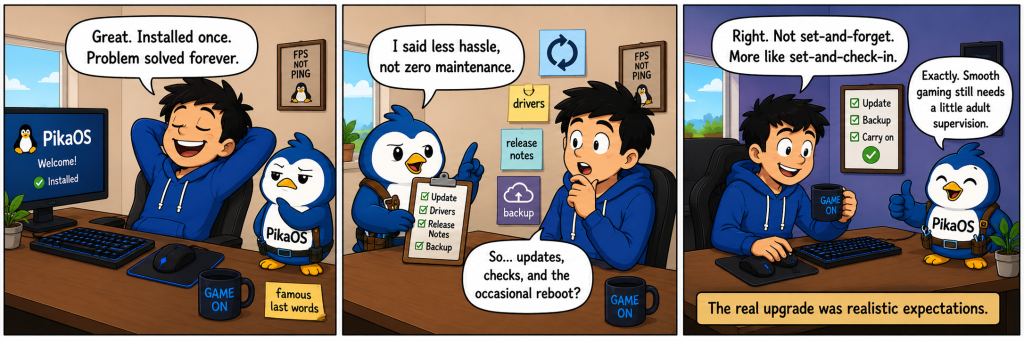
There have also been sharp edges. The official wiki currently carries an alert that installations before 3 February 2026 may need to migrate to KBD if keyboard issues are experienced. That is not a scandal; it is a reminder. PikaOS lives closer to the performance-and-freshness end of the Linux spectrum than the “install it and forget it for five years” end.
The 2026 release notes reported by LinuxCompatible show that PikaOS 26.04.04 brought a newer kernel, NVIDIA driver updates, and a default move to XFS for fresh installs, while existing users would receive updates through repositories. That is the kind of evolution that keeps a gaming distro relevant, but it also means users should read release notes, keep backups, and avoid treating any bleeding-edge-ish setup like a toaster.
The appeal of PikaOS is that it has a personality. It is not pretending to be a corporate desktop platform. It has a cute bird mascot, strong opinions, a gaming-first attitude, and a willingness to make non-default choices if they improve the experience. Even the project’s own blog argues that PikaOS 4 was not meant to be just a gaming distro with Steam preinstalled, but a rethink of what a modern Debian-based distribution could feel like. That is the right ambition.
The Linux desktop does not need another distribution that changes the wallpaper, adds a welcome screen and calls it innovation. It needs distributions that solve annoying problems. PikaOS is interesting because it is trying to solve a real one: how to make a Debian-based system feel modern, fast, gaming-ready and approachable without turning the user into the system administrator of a tiny private data centre.
Who is it for? Probably gamers who like Linux, Linux users who want gaming without manual assembly, creators who need fresh graphics and multimedia packages, and power users who like Debian but want something more energetic than traditional Debian stable. It may also appeal to people coming from Nobara, Bazzite, CachyOS or Garuda who want a different base with a similar “we tuned the annoying bits for you” philosophy.
Who is it not for? People who want maximum conservatism, enterprise-style predictability, or the slow calm of Debian stable. PikaOS is friendly, but it is not sleepy. That is the trade-off, and it is not a bad one. Linux gaming has matured enough that users can now choose between different flavours of convenience. Some want immutable systems. Some want Arch speed. Some want Fedora polish. PikaOS makes the case for a Debian route: familiar foundations, modern packages, gaming defaults, custom tools, and enough personality to avoid feeling like a generic remix.
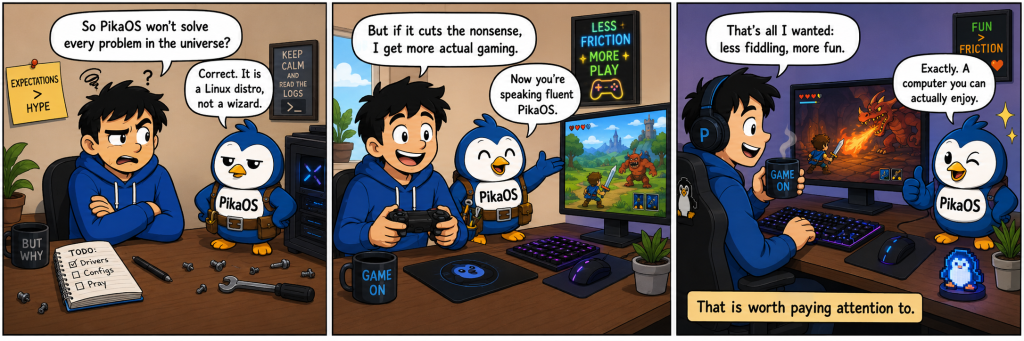
The best thing about PikaOS is that it seems to understand the real enemy. The enemy is not Windows. The enemy is friction. The driver hunt. The post-install checklist. The half-working controller. The outdated package. The “almost there” experience. PikaOS is trying to make Linux gaming feel less like a project and more like a computer you can actually enjoy. That is worth paying attention to.