Spotify pausing every ~30 seconds is usually not a normal glitch but something actively sending pause commands—most often Discord’s Spotify integration, other third-party apps, ghost devices, or Spotify Connect sessions fighting for control.
86Box emulates IBM PC hardware from the original 1981 era to late-1990s systems—recreating processors, BIOS, sound cards, graphics adapters and storage controllers to preserve the messy reality of early personal computing.
Point-and-click adventure engine lineages from Sierra AGI/SCI to SCUMM, ScummVM, AGS, Wintermute, Visionaire, Unity, Godot and modern frameworks—separating true lineages from influences and reimplementations.
Microsoft Activation Scripts, or MAS, became popular because software activation can be confusing and frustrating. But unofficial activation tools also raise serious licensing, legal, and security questions.
MiniIRC and MiniTelnet bring the classic Amiga back online without the weight of the modern web. Small, sharp, and full of character, they reconnect old hardware to IRC channels and BBS worlds where the internet still feels personal, direct, and alive.
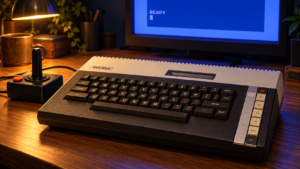
Atari’s brown-and-cream computing days are returning. Announced on 8 October, THE 800XL recreates the 1983 home computer with a full-size mechanical keyboard, built-in Atari BASIC and a working cartridge slot. Designed by Retro Games Ltd. and manufactured and distributed by PLAION REPLAI, it is available to preorder for £199.99 / €219.99 / US$219.99, with shipping scheduled for 23 April 2027.
The machine includes 25 games, among them Boulder Dash, M.U.L.E. and Yoomp!, plus USB loading for additional software. HDMI output, four USB-A ports, save states and a 30-second rewind bring modern conveniences, while an updated THECXSTICK joystick comes in the box. With BASIC supporting writing, saving and loading programs, there is also an invitation to spend an evening making something yourself.
The death of a worker at the Irkutsk Anti-Plague Research Institute in Siberia has prompted quarantine measures and medical monitoring of her contacts. Russian authorities attribute her death to pneumonia of an undetermined cause and say they found no evidence of an accident involving pathogens. Reports suggesting pneumonic plague remain unconfirmed. The World Health Organization says the risk to the general public appears low, based on the information available.
For anyone following the developing story, Something Big’s Russia Plague Tracker brings together a timeline, map and linked sources, distinguishing confirmed information from disputed claims. Its latest update lists one death with an unconfirmed cause and no confirmed plague cases linked to the incident. It also reports that contacts tested negative for plague, with 60% having completed observation by 5 October.
The central question remains unanswered: what caused the worker’s fatal illness? Until that is established, claims of a confirmed plague outbreak go beyond the available evidence.
Voice-intelligence company Modulate has raised $25 million to expand its fraud-detection and audio-analysis technology. The round was led by Future Ventures, with Hyperplane and Lakestar also participating, bringing Modulate’s total funding to $60 million.
Its Velma platform analyses audio directly using more than 100 specialised models, looking beyond transcripts to identify synthetic speech, intent, emotion, tone and suspicious conversational behaviour. The technology is intended for applications including deepfake detection, call-centre fraud prevention, AI-agent supervision and online safety.
Modulate plans to use the investment to develop additional models, APIs and deployment options while expanding its engineering team and partner network. As cloned voices become increasingly convincing, real-time detection could become an important security layer for financial approvals, customer-service calls and executive communications.
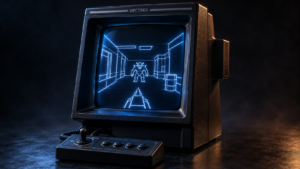
DOOM has found another unusual home: the Vectrex. Jason Kopp, aka Arcade Jason, has brought the classic shooter to the console through his UVMC2 cartridge, with gameplay footage showing E1M2 rendered in glowing vector outlines.
The cartridge’s modern processor does the heavy lifting, while the Vectrex provides its distinctive display and controls. The result gives familiar DOOM corridors a striking new look.
Creating a Game Boy RPG could soon become easier with RPGSoup, a reusable GB Studio plug-in inspired by SaGa and other classic JRPGs. Developer Cooby_Pls is building a framework that lets creators define characters, items, equipment, spells, enemies and animations while it handles the underlying systems.
Still in development, RPGSoup is planned as a free release, accompanied by a complete sample RPG demonstrating its features. The aim is to give developers a foundation they can add to existing projects and build upon.
Star Wars: X-Wing has another route back into the cockpit. OpenXW is an open-source reimplementation that runs the original game data natively on Windows, macOS and Linux. Its latest release, version 0.0.3, arrived on 29 September.
Its most interesting feature is the ability to combine two editions: the 1994 Collector’s CD-ROM menus, cutscenes and adaptive iMUSE soundtrack with the 1998 version’s flight simulation and 3D assets. That means keeping the later flight presentation without losing music that responds to events during a mission. Either edition can also run independently.
Modern graphics options include high-resolution rendering, shadows, ambient occlusion, anti-aliasing, AMD FSR upscaling and HDR, while a classic mode preserves the original appearance. OpenXW also offers smoother flight timing and configurable mouse, gamepad and joystick controls.
The latest update adds a laser convergence option, improves performance and motion blur, and fixes a freeze associated with recording during missions, alongside missing explosions in the 1993/1994 graphics modes.
Original game files are required: OpenXW includes no game content. A complete 1994 or 1998 installation is needed, with both required for the combined configuration. Development remains ongoing, so bugs and differences from the originals are still possible.
School’s nearly out—and an evil computer wants to take over the world. Escape from 8-Bit High, developed by Duck Made Of Wood and published by Dionous Games, is scheduled to launch on Steam on 29 September 2026, mixing classic point-and-click adventuring with arcade-inspired musical battles.
When a mysterious cassette awakens the sinister Pomodore 64, rock trio Blueberry Finn must save Cloudydale from an invasion of pixel-era villains. Players can switch freely between bandmates Hank, Duck and Alex, following interconnected adventures through a monster-infested school, outer space and the depths beneath the Earth. Choices shape the story—and can even change the main villain between playthroughs.
The developer promises 8–10 hours of gameplay, full voice acting, four unlockable arcade mini-games and new songs to discover. Hotspot highlighting and an objectives journal should help keep the puzzles moving. A free demo is already available on Steam, alongside the wishlist option.
h4x (@c0ner0ne) reports successfully decrypting firmware for the Uniden SDS100E radio scanner—a potential step towards deeper examination of its internal software. The announcement concerns firmware decryption, not the cracking of encrypted radio communications, and does not by itself demonstrate new scanning capabilities or a ready-to-install custom firmware.
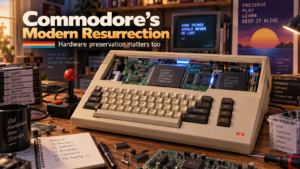
Commodore wants its revival to mean more than another familiar logo on a box. Speaking to FRVR, chief strategy officer Jim Squires stressed that preserving hardware matters alongside saving old software. With ageing C64s increasingly being cannibalised for spare parts, the Commodore 64 Ultimate is intended to help keep the platform alive through an FPGA recreation of the original machine.
That approach extends to accessories: the revived TAC-2 joystick preserves the classic design while introducing a stronger steel shaft.
Squires also credited the homebrew and demoscene communities that never stopped developing for Commodore machines. The stated ambition is to preserve how these systems feel and play—not simply cash in on their name. Less souvenir, more working computer.
Who needs a graphics card when you have a microcontroller and a stubborn refusal to accept its limitations? CubeCoders’ Jet Megatextures Demo adapts James D. Lambert’s Nintendo 64 chapel demo for the ESP32-S3, rendering everything in software using the Jet engine. A 90-second camera tour explores stained-glass windows and detailed stonework, with optional controls for looking around freely.
The trick is making simple geometry look expensive: 325 triangles, 18 textured materials and a 5.01 MiB texture pack. The colourful lighting is baked into the artwork rather than calculated dynamically, while a cache reuses filtered texture samples to reduce rendering work. The complete reduced texture pack fits in memory, so this is not a demonstration of streaming a world larger than RAM.
The tested setup uses a 240 MHz ESP32-S3 with 8 MiB PSRAM and 16 MiB flash, driving a 480×320 display through half-width rendering and alternating fields. Source code, converted assets and build instructions are available on GitHub. Tiny hardware, thoroughly oversized ambition.
A rumor that the complete Avengers: Doomsday has leaked in 2160p began circulating on X on September 20, three months before the film’s December 18 theatrical opening.
Fan accounts and scoopers said a “reputable P2P uploader” possessed a 4K screener. Several posts added that the file had no audio. Cosmic Book News and ComicBookMovie both reported the claim and stressed it was unconfirmed. Marvel Studios has issued no statement.
An image said to show Robert Downey Jr. as Doctor Doom, flanked by damaged Sentinels against a burning Earth, circulated alongside the rumor and reportedly passed some AI-detection checks. That still does not prove a finished feature exists online.
Trade and fan coverage notes the film only recently finished reshoots and is expected to remain in post-production into November, which makes a completed, theatrical-ready 4K copy circulating now unlikely. Earlier Doomsday clips that appeared in June were later hit with copyright takedowns.
History is cited as a warning: when a workprint of X-Men Origins: Wolverine leaked in 2009, the uploader later went to federal prison.
Official new Doomsday footage is already scheduled to appear in theatres with Avengers: Endgame Encore beginning September 25. The studio’s silence so far should not be read as confirmation that a full movie is out there.
Treat the 4K leak story as rumour until a verifiable source, file details, or a studio response appears.
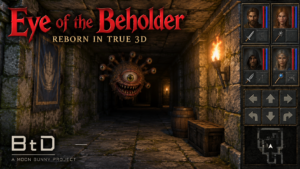
Eye of the Beholder is getting a rather unusual second life. BtD, an experimental engine created by Moon Bunny, reimplements the 1991 dungeon crawler as a true 3D first-person experience with smooth, continuous movement instead of the original game's grid-based steps and 90-degree turns.
This isn't simply a remake with prettier graphics. BtD reads the original DOS Eye of the Beholder data files, retaining the game's dungeons, puzzles, scripts and underlying content while interpreting them inside a modern Unity-based engine. No original game assets are distributed with the project, so you'll need a legitimate DOS copy of Eye of the Beholder to use it.
The developer says considerable effort has gone into keeping the original logic intact, including writing a virtual machine capable of processing the game's original level scripts. Enemies have received some modernisation too, including pathfinding better suited to unrestricted 3D movement.
BtD originally entered open beta in May 2026, and the project has recently started attracting fresh attention after footage of it resurfaced online. If you've ever wondered what Eye of the Beholder might have felt like had Westwood's dungeon been freed from its invisible grid, this is probably about as close as we're going to get.
Apparently, nobody told the Game Boy Advance that Skyrim was out of its league. Solo developer blast_away has unveiled SkyGBA, a homebrew project that recreates Skyrim’s map as a GBA ROM. Before anyone starts planning another hundred-hour adventure, this is a map tech demo—not a full port of the game.
The project uses a custom 3D engine running in the GBA’s Mode 4, turning the landscape into a decidedly low-resolution handheld experiment. The trailer’s description specifies that the footage was captured using mGBA through RetroArch, so it should not be mistaken for a demonstration filmed on original hardware.
In the announcement’s comments, the developer says a downloadable ROM is planned, with a link to be added to the YouTube comments; joining Discord will not be necessary. That is a promised release, rather than a confirmed download available now.
The complete engine source is less likely to follow: its creator wants to use it for an original game, although some code snippets may be shared. For now, consider this a wonderfully unreasonable sightseeing trip rather than Skyrim: Pocket Edition.
Apparently blackjack was getting far too comfortable with modern hardware.
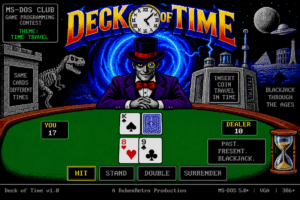
Deck of Time is a new humorous card game created for MS-DOS, combining blackjack with a deliberately 1990s PC aesthetic and enough weirdness to ensure nobody mistakes it for serious casino software. The game was created by RubenRetro for the second MS-DOS Club DOS Game Programming Contest, whose theme this year is time travel.
Underneath the jokes is a genuinely old-school DOS game. Deck of Time is written in C, uses Allegro 4.2.3, requires only a 386 or faster, 4 MB of RAM and VGA graphics, and will run under MS-DOS 5.0 or later. In other words, your forgotten beige box in the attic may finally have an important job again.
The game takes the familiar blackjack formula and wraps it in a much less familiar presentation involving time-themed nonsense, an intimidating dealer and multiple outcomes. There is even an intentionally retro-style age check, because apparently getting into a DOS blackjack game in 2026 should involve proving that you survived enough of the 1990s to understand the references.
Deck of Time was published on 11 September 2026 and received an update on 16 September. A downloadable DOS version is available, along with a Windows x86 build, but you can also play the whole thing directly in a modern browser through itch.io.
So yes: we have reached the point where people are developing completely new blackjack games for MS-DOS again.
Somebody has looked at Windows 3.1, looked at Quake, and decided that these two pieces of 1990s technology needed to spend more time together.
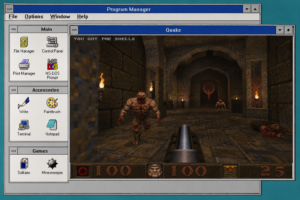
The result is quakegeneric-Win31, an open-source project that brings id Software’s legendary 1996 shooter to Microsoft’s decidedly pre-Windows 95 environment.
And this isn’t simply the DOS version of Quake being launched underneath Windows. The project uses WinG, Microsoft’s old high-performance graphics API for Windows 3.x, to get Quake running as a Windows 3.1 application.
The requirements are surprisingly serious for something sharing a desktop with Program Manager. You’ll need an FPU-equipped processor, with a Pentium or better recommended, at least 16 MB of available RAM, WinG installed, and a display mode supporting 32,768 colours or more.
It is also considerably more functional than you might expect. Sound output is supported in mono or stereo, saving and loading work, and there is proper mouse control. The supplied configuration even provides WASD movement and mouse-look, although right-click is reserved for grabbing and releasing the mouse cursor.
The developer has tested the port with Windows 3.1 inside DOSBox-X and with the FM TOWNS version of Windows 3.1 running under the Tsugaru emulator. There are still some quirks, particularly under DOSBox-X, so testing on real period hardware is actively encouraged.
Is there any practical reason to play Quake this way?
Absolutely not.
Which is precisely why we’re delighted that it exists.
Apple unveils the iPhone Duo. PARKSIDE looks at the price, looks at two iPhones and thinks: hold my screwdriver.
The power-tool brand posted its own interpretation of Apple’s new foldable on social media: two iPhones, a hinge, four screws and a healthy dose of cordless screwdriver.
No aerospace-grade titanium, no hinge engineered for years in some secret Cupertino laboratory and, most importantly, no €2,369 starting price, climbing all the way to €3,869 for the 2 TB version.
PARKSIDE instead appears to suggest a far more democratic DIY approach: buy two phones and destroy them yourself.
Before anyone rushes to Lidl to try it: no, this is not a tutorial. PARKSIDE’s image was generated using AI, and apparently no innocent iPhones were actually drilled during the making of the joke.
Shame, really. For a few seconds, the internet had finally found a convincing use for artificial intelligence.
Still, it says something when faced with an Apple phone costing nearly four thousand euros, the most reassuring piece of technology in the picture is a PARKSIDE cordless screwdriver.
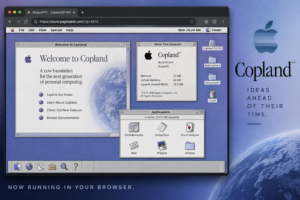
One of Apple’s strangest unfinished chapters has just become much easier to explore. Michael Steil has managed to get Copland D11E4, the final publicly available build of Apple’s abandoned next-generation operating system, running inside an improved version of the DingusPPC emulator — directly in a web browser.
Copland was Apple’s ambitious mid-1990s attempt to replace System 7 with a considerably more modern architecture, including a microkernel, virtual memory and pre-emptive multitasking. The project was eventually cancelled, with Apple instead acquiring NeXT and following the technological path that would ultimately lead to Mac OS X.
The browser version uses WebAssembly and, according to Steil, a modern computer can emulate the system at roughly the speed of the original hardware. Getting D11E4 running required 11 patches to DingusPPC. Once booted, you can actually poke around Copland and try surviving software such as GXSlidemaster and Eric’s Solitaire.
It is unstable, unfinished and occasionally drops straight into a debugger — which, frankly, makes it an even more authentic visit to one of computing history’s most fascinating dead ends.
The Master System isn’t done saving the universe. Razing Core, released by Bad Computer on 8 September, is a new vertical shoot ’em up for the Sega Master System and Mark III, sending the spaceship Horizon into battle against an invading alien armada.
There are seven stages across the solar system, upgradeable primary, secondary and Core weapons, plus a Burst Charge attack with five charge levels. Screen-filling bosses and multiple mid-bosses provide the opposition, while boss checkpoints and unlimited continues offer some breathing room between explosions. Mega Drive controllers are also supported, giving the three attacks their own buttons.
The game is available on itch.io from US$7.99, with a printable illustrated manual and a free first-stage demo. It comes as a Master System ROM for compatible emulators, FPGA systems or original hardware with a suitable flash cartridge, and is designed for 60 Hz play. A physical edition is planned for 2027.
One caveat for EverDrive X7 owners: the developer reports that using save states can reset the game in some areas, with a fix planned for the next update.
An elusive piece of PlayStation 2 hardware has finally surrendered its firmware. DiscoStarslayer has announced a breakthrough in dumping early PS2 MechaCon security controllers, following four years of reverse engineering. The research progressed from physically exposing the silicon and optically reading its memory to a software-based extraction method, with fellow researcher Libby credited for discovering the crucial exploit.
MechaCon does more than control the disc drive: it also handles security functions including MagicGate memory-card authentication and the decryption of protected executables. Access to its firmware gives researchers valuable material for investigating vulnerabilities and developing more faithful, low-level emulation of the console.
The important distinction is that this is a research and preservation milestone, not a newly released universal jailbreak. Research contributor uyjulian also cautions that the dumps alone do not provide enough information to build an optical-drive emulator. Better understanding of Sony’s hardware is the immediate win; new modifications and practical applications still require further work.
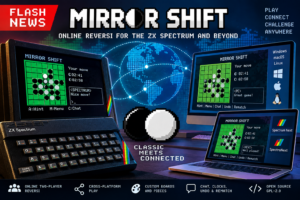
Mirror Shift 1.0, released on 9 September 2026, brings two-player online Reversi to the ZX Spectrum 48K, Spectrum Next and SpectraNext cartridge, alongside Windows, macOS and Linux. Created by M. Ignacio Monge Garcia, the game supports cross-platform matches: a classic Spectrum can challenge a modern desktop, another Spectrum or one of its newer relatives.
Players connect through direct TCP or MQTT, with the latter allowing both opponents to join a shared server and room without requiring an incoming connection to the host. There are legal-move hints, in-game chat, clocks, rematches and requests to undo a move, plus saved games that can be resumed with both players’ approval. Customisable boards and disc sets add some visual variety, while the Next edition benefits from full-colour tiles and hardware sprites.
The game is open source under GPL-2.0, with ready-to-run packages and source code available on GitHub. One practical detail for original Spectrum owners: the Classic version requires divMMC/esxDOS storage and a supported ESP-AT networking interface. Your rubber-keyed machine can join the match, but it needs a little help getting online.
Pararena has landed on Playdate, bringing John Calhoun’s Macintosh hoverboard game to a new handheld audience. Released on 14 September 2026, this independent port by Konstantin Popov adapts the original artwork for Playdate’s screen. It follows the release of the source code for Pararena 2.0, originally published by Casady & Greene, under the MIT licence.
The premise is wonderfully odd: two hoverboard riders chase a ball around a bowl-shaped arena, trying to throw it into their respective goals. Gravity complicates the steering, while boosting, braking and knocking your opponent aside keep things lively. Holding the ball too long or throwing it out earns a foul, with three fouls awarding your rival a point.
The port includes six computer opponents, five leagues, quick matches, a tournament and a practice mode, alongside instant replays, statistics and records.
Pararena for Playdate is available on itch.io for US$2.50 or more.
Until 20 September 2026, a US$4 Macintosh Classics for Playdate bundle also includes Popov’s port of Continuum, Brian and Randy Wilson’s gravity-driven space game. Two opportunities to revisit Macintosh gaming without clearing desk space for an old beige computer.
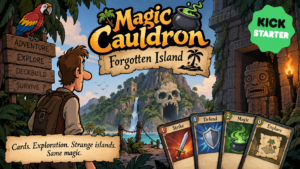
Indie developer Manuel Schenk has launched a Kickstarter campaign for Magic Cauldron: Forgotten Island, a new turn-based adventure that mixes deckbuilding and card-based combat with elements of traditional point-and-click adventures. The campaign launched on 12 September and is seeking €3,000 in funding, with the game planned for Windows, macOS and Linux. At the time of writing, the campaign has already attracted its first backers and is scheduled to run until 3 October 2026.
Set once again in Schenk's wonderfully odd Magic Cauldron universe, Forgotten Island swaps the more conventional adventure-game structure of earlier entries for turn-based exploration and deckbuilding battles, while retaining the series' humour and eccentric fantasy setting. The developer describes it as a combination of a deck-builder, turn-based combat and classic point-and-click adventure elements.
Schenk has been steadily experimenting with different takes on retro-style adventure games for several years. His previous releases include the comic point-and-click adventures Nelson and the Magic Cauldron from 2018 and Nelson and the Magic Cauldron: The Journey from 2022, as well as the excellent-looking pixel-art sci-fi adventure Orbital Cargo Division from 2023. More recently he expanded the Magic Cauldron setting with the retro-inspired dungeon crawlers Magic Cauldron: Dungeons and Dungeons II.
It is an interesting change of direction for a developer whose work has so far been strongly rooted in classic adventure gaming, and one that still seems determined to keep plenty of the humour and old-school flavour of his earlier games.
The Sega Master System has another homebrew to explore: Oriflame, an arcade puzzle game from ArtOfAltair, published on itch.io on 7 September 2026. Inspired by Adventures of Lolo and classic arcade design, it challenges players to climb 50 floors of the Tower of Hope, solving puzzles, confronting enemies and lighting fires to reach the summit and restore its beacon.
This is not simply a modern game wearing an 8-bit disguise: Oriflame is a genuine Master System ROM, playable through an emulator or on the original console using a compatible flash cartridge. The developer describes a “gameplay first” approach, deliberately working within the hardware’s strengths and limitations. It is an independent production, with no involvement from Sega.
Available for US$9 or more, the download includes the game, an instruction manual containing controls, rules and passwords for every level, plus soundtrack files in VGM and MP3 formats.
South Park is becoming “South America” — in a satirical swipe at Donald Trump’s geographic renaming campaign. Creators Trey Parker and Matt Stone announced the change ahead of the show’s 29th season, with promotional artwork covering “Park” on the familiar town sign with an “America” sticker.
The statement sarcastically credits the “bravery and patriotism” of Apple and Google, which adopted “Lake America” for Lake Ontario on their US maps following Trump’s renaming order. The creators also take a shot at their own parent company, thanking Paramount while describing it as “a Skydance Capitulation”.
Season 29 premieres on 16 September 2026 at 10 p.m. ET/PT on Comedy Central, with next-day streaming on Paramount+ in the US, Canada and Australia. Five further episodes are scheduled fortnightly through 25 November.
Whether “South America” will stick permanently remains unclear: the announcement is another satirical provocation, rather than confirmation of a lasting replacement for the original title.
ZuckOff, an app developed by Pawel Szydlowski, can flag nearby camera-equipped smart glasses by recognising their Bluetooth signals. Supported devices include Ray-Ban Meta, Oakley Meta and Snap Spectacles, giving users a way to spot hardware that might otherwise go unnoticed.
The app examines manufacturer identifiers and other broadcast information, explains why a device was flagged and uses signal strength to estimate proximity. However, it cannot indicate the direction of the glasses or pinpoint their wearer.
On iPhone, basic scanning is free, while ZuckOff Pro adds background monitoring, notifications, widgets and extended detection history. According to the developer, logs remain on the phone unless users explicitly export them or submit a hardware report.
The crucial limitation: detecting glasses does not mean someone is recording. ZuckOff identifies nearby devices, not what their cameras are doing. Conversely, glasses that stop broadcasting may go undetected, so an empty scan is not a guarantee that nobody is filming. It is an awareness tool, not a recording detector.
Sony’s original grey PlayStation is getting the LEGO treatment. Revealed on 3 September 2026, LEGO PlayStation (72306) is a 1,911-piece, near-life-size recreation of the console, complete with a brick-built version of its original controller. Designed for builders aged 18 and over, it is a display model rather than a working games machine.
The nostalgic details go beyond the familiar shape: the controller plugs into the front, while mechanical Open and Power buttons add something to fiddle with. Hidden inside are two removable dioramas celebrating Gran Turismo and Ape Escape, featuring a miniature racing circuit with tiny cars and a scene incorporating the monkeys’ distinctive helmets. Both can stay concealed or be displayed separately.
The set costs £139.99 / €159.99 / $179.99, with LEGO Insiders early access starting on 1 October 2026 and general availability from 4 October. The finished console measures approximately 26 × 19 × 6 cm—a manageable slice of PlayStation nostalgia for the shelf. The startup sound, unfortunately, is yours to provide.
Amazon has introduced visual dubbing on Prime Video, using artificial intelligence and visual effects to modify actors’ mouth movements so they match translated dialogue. Crucially, the voices remain human-dubbed: this feature changes the picture rather than replacing voice actors with synthetic speech.
The technology is now available worldwide for the English-dubbed versions of Maxton Hall seasons 1 and 2. It will also feature in the third and final season, scheduled to premiere on 9 December 2026. The aim is to reduce the distracting mismatch between spoken words and the actors’ lips when watching a translated production.
Amazon plans to extend visual dubbing to more titles and says the process operates under creative oversight to preserve the creators’ artistic vision. However, its announcement does not identify the next productions or provide a timetable for additional languages.
Buried Magic: A Story about the Unseen is seeking support on Kickstarter, promising a spooky, hand-drawn point-and-click adventure from Playful Bunny Interactive. The campaign is led by creator Annika Veigel and combines a witchcraft-school setting with traditional adventure-game puzzle solving.
Players follow Ruby, a young witch student investigating strange disappearances in Hollowmoor, where the centuries-old Trinity Academy of Witchcraft sits at the centre of the mystery. Accompanied by her tiny house-spider companion, Mifi, Ruby must explore unsettling locations and uncover the secrets hidden within her school.
The developer highlights hand-drawn graphics and animation, object-based puzzles, and dynamic interactions and responses. The emphasis is on exploration and piecing together the mystery, giving the project a distinctly traditional point-and-click flavour beneath its supernatural setting.
The campaign has a €3,000 funding target and runs until 16 October 2026, with funding dependent on reaching that goal.
The game is available to wishlist on Steam, where a Windows release is currently planned for May 2027; that remains a development target rather than a guaranteed launch date.
Developer GammaCorrection has shared a preview of Jacob’s Elevator, a homebrew game in development for the Nintendo Entertainment System. In the accompanying Reddit discussion, the creator confirmed that the project is being programmed in assembly language.
There is a touch of oddball humour, too: when a commenter compared a tree character to Zelda’s Deku Tree, the developer clarified that this is the “Wise Mystical Tree”, a distinct character.
The finished game is planned as a free release on itch.io, with the option to play directly in a web browser. For now, however, this is a development preview rather than a launch: the announcement gives no release date, and Jacob’s Elevator is not yet listed on the developer’s itch.io profile.
Developer Costélinha (GuilhermeJuventino) has released Car Go Vroom!!!, a new homebrew racing game for the original Nintendo Game Boy. The small 2D racer is written in Assembly using RGBDS and challenges players to dodge oncoming cars while pushing for higher scores.
The finished ROM was published on 5 September 2026, with the complete source code also available publicly on GitHub. The project had previously been shown in development posts dating back to 2025.
Unico is preparing the Traveller ULW10, a compact LCD monitor designed specifically for retro gaming, combining a classic 4:3 format and CRT/PVM-inspired styling with modern display technology.
The ULW10 is built around an approximately 10-inch screen and supports RGBs and VGA for older hardware alongside HDMI for modern systems. Unico is positioning it as a convenient modern alternative for players who want the proportions and feel of classic gaming displays without relying on ageing CRT hardware. A Kickstarter campaign is currently being prepared.
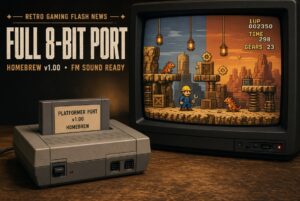
Homebrew developer LackofTrack has released version 1.00 of an unofficial Super Mario Bros. port for the Sega Master System, turning an earlier proof of concept into a complete game.
The port aims to closely reproduce the original NES/Famicom gameplay while also offering an enhanced graphics mode inspired by Super Mario All-Stars. An optional FM soundtrack is available for compatible Master System hardware equipped with a YM2413 chip.
The project was originally developed for the 2026 SMS Power coding competition and is now available as a full release.
REASSEMBLER has released the first public playable demo of Aonic, an ambitious attempt to bring the original Sonic the Hedgehog experience to the Commodore Amiga. The current build recreates Green Hill Zone Act 1 and targets PAL Amigas with the AGA chipset and just 2 MB of Chip RAM, making a stock Amiga 1200 the project’s main reference system.
Rather than simply creating a Sonic-inspired platformer, Aonic adapts code, game logic and data from the original Mega Drive version while heavily reworking the rendering system for the very different Amiga hardware. The aim is to preserve Sonic’s familiar physics, momentum and speed as closely as possible.
The demo became publicly available on itch.io on 31 August 2026 under a name-your-own-price model and remains a work in progress. REASSEMBLER has also discussed eventually investigating an Amiga 500 version, although finishing the AGA release comes first.
GOG-Games.to, the unofficial piracy website specialising in DRM-free PC games, scheduled its closure for 6 September 2026, following a 90-day notice issued in June. The announcement said new game additions and updates would cease, with the website subsequently going offline.
The operator described the closure as a personal decision, rather than the result of legal pressure. According to the notice, approximately €700 in remaining Monero donations would be passed to the file-sharing community Torrminatorr, alongside a thank-you to everyone who had supported the site.
Despite the similar name, GOG-Games.to is not affiliated with GOG.com. The legitimate DRM-free games store remains online: this announcement concerns the separate piracy website, not the official GOG service or its customers’ game libraries.
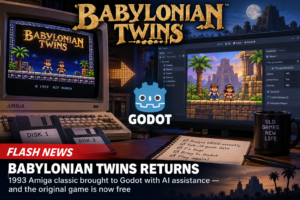
Babylonian Twins creator Rabah Shihab has revealed how he used Anthropic’s Claude to bring his 1993 Amiga puzzle-platformer into Godot. The project tackled both the original Motorola 68000 assembly and the C++ engine developed for its 2010 mobile remake.
According to Shihab, the AI analysed 72,758 lines of Amiga assembly, recovered undocumented level formats and helped rebuild the original game binaries. But this was no flawless, one-click conversion: bugs involving enemies, doors and jumping still required human playtesting and corrections.
For Amiga fans, there is an immediate bonus: the complete original game—not just the previously available demo—is now free on itch.io, supplied as two ADF disk images for emulators or compatible Amiga hardware. The modern Definitive Edition is already available on iOS and Android, while Steam offers a free demo ahead of the full release.
Limited Run Games and Cyan Worlds are bringing the modern remakes of Myst and Riven to physical media. Standard editions are planned for PlayStation 5 and Xbox One/Xbox Series, alongside retro-inspired Big Box Editions for PlayStation 5, Xbox and PC via Steam. The new versions retain the surreal worlds and puzzle-driven exploration of the CD-ROM classics while rebuilding them with modern visuals, lighting and full movement. Pre-order dates and prices have not yet been announced, with all editions currently listed as coming soon.
Game Boy Color is getting a taste of futuristic racing with ZERO, an upcoming project from Shane McCafferty of Rocketship Park. Inspired by F-Zero, it aims to recreate the feel of SNES-style Mode 7 racing on Nintendo’s pocket-sized hardware.
Publisher Thalamus Digital has unveiled an official page teasing an anti-gravity racing tournament. The game is currently advertised as “coming soon”, with no firm release date listed. Another ambitious homebrew project to keep on your radar!
We use cookies on our website to give you the most relevant experience by remembering your preferences and repeat visits. By clicking “Accept All”, you consent to the use of ALL the cookies. However, you may visit "Cookie Settings" to provide a controlled consent.
This website uses cookies to improve your experience while you navigate through the website. Out of these, the cookies that are categorized as necessary are stored on your browser as they are essential for the working of basic functionalities of the website. We also use third-party cookies that help us analyze and understand how you use this website. These cookies will be stored in your browser only with your consent. You also have the option to opt-out of these cookies. But opting out of some of these cookies may affect your browsing experience.
Necessary cookies are absolutely essential for the website to function properly. These cookies ensure basic functionalities and security features of the website, anonymously.
Cookie
Duration
Description
cookielawinfo-checkbox-analytics
11 months
This cookie is set by GDPR Cookie Consent plugin. The cookie is used to store the user consent for the cookies in the category "Analytics".
cookielawinfo-checkbox-functional
11 months
The cookie is set by GDPR cookie consent to record the user consent for the cookies in the category "Functional".
cookielawinfo-checkbox-necessary
11 months
This cookie is set by GDPR Cookie Consent plugin. The cookies is used to store the user consent for the cookies in the category "Necessary".
cookielawinfo-checkbox-others
11 months
This cookie is set by GDPR Cookie Consent plugin. The cookie is used to store the user consent for the cookies in the category "Other.
cookielawinfo-checkbox-performance
11 months
This cookie is set by GDPR Cookie Consent plugin. The cookie is used to store the user consent for the cookies in the category "Performance".
viewed_cookie_policy
11 months
The cookie is set by the GDPR Cookie Consent plugin and is used to store whether or not user has consented to the use of cookies. It does not store any personal data.
Functional cookies help to perform certain functionalities like sharing the content of the website on social media platforms, collect feedbacks, and other third-party features.
Performance cookies are used to understand and analyze the key performance indexes of the website which helps in delivering a better user experience for the visitors.
Analytical cookies are used to understand how visitors interact with the website. These cookies help provide information on metrics the number of visitors, bounce rate, traffic source, etc.
Advertisement cookies are used to provide visitors with relevant ads and marketing campaigns. These cookies track visitors across websites and collect information to provide customized ads.